Summary
- Customer interviews are not limited to customers. You can gain insights from anyone that you seek to better understand, managers, employees, and even family.
- Customer interviews are not a conversation. They are a skill that needs to be developed like any other.
- The insight that is gained from customer interviews should be verified by the interviewee and others you are interviewing. The findings should be shared with everyone that is serving those customers.
Personal Parable
Many years ago I got a job of being the product owner for an internal software delivery team. At the time there was a decent knowing-doing gap in my capabilities. I had learned a great deal about the role through reading and training, but I had never done it before. While my technical background made me ready to understand the underlying product, the unique demands of understanding and serving customers, stakeholders, and management were new to me.
One of my immediate frustrations was I rarely had what the director of our group wanted. He would ask something like “What is our volume by business unit?” He might as well have been asking a fish for a new car. I had more questions than answers. The volume of what, messages/memory/users, and which business unit do you mean? The one creating transactions, receiving them, and at what level of granularity do you mean like our sales unit or Justin’s team?
It never felt like I provided a satisfactory answer. He often left frustrated. Luckily I had a tool from product management to help in this situation, and that was user interviews. I recently read Interviewing Users: How to Uncover Compelling Insights by Steve Portigal which was recommended to me by Charles Lambdin, who shares his insights on, The Lateral Lens, which I highly recommend.
Customer Interviews
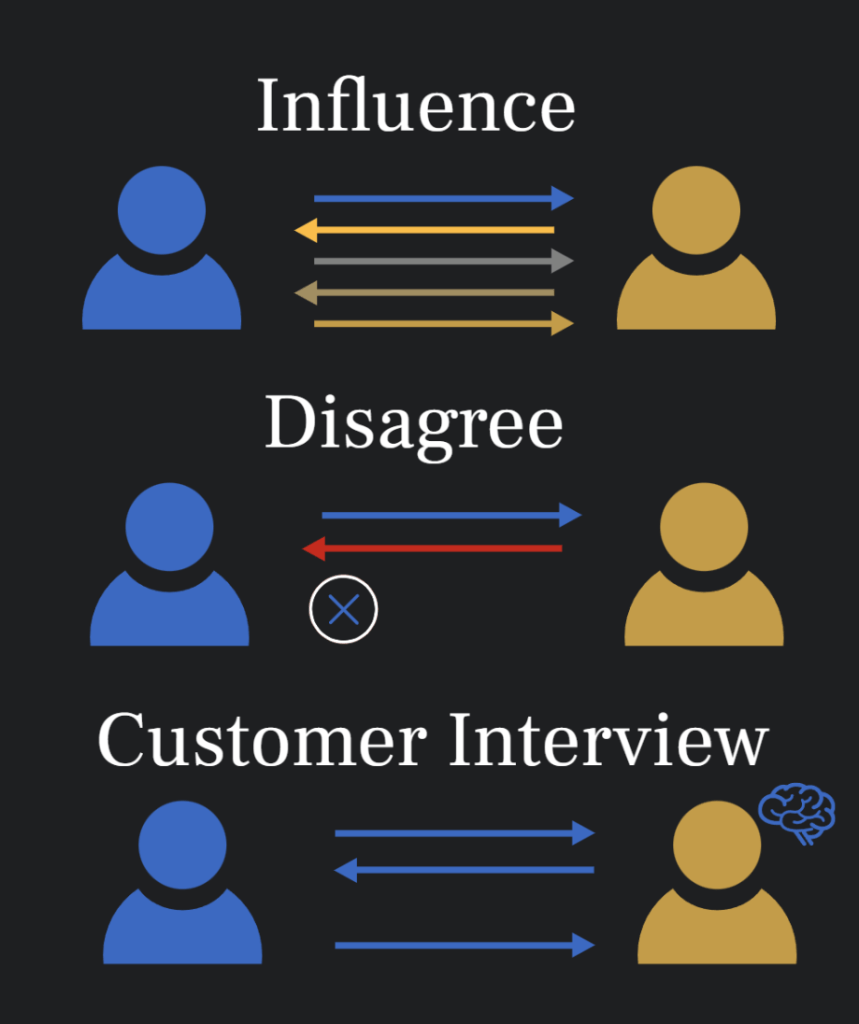
A customer interview is not a conversation. You aren’t there to debate, you are there to gain understanding. This is a very unnatural skill. You need to remain passive in opinion but participate by using active listening. This means showing that you are hearing what they are saying by saying it back. Doing this in a way where you acknowledge/validate what they are saying. This is sometimes referred to as mirroring.
Then ask clarifying questions. Here is a simple example:
Customer: I am so frustrated with your stupid system.
Interviewer: You are really frustrated, what makes it awful for you?
The goal is to make sure they are heard and to keep asking for clarification to gain understanding. In a normal conversation, you may be tempted to disagree with them or show them how to fix a problem, educate, or influence them. This stops the dialog, your goal is to maximize the information they provide and thus grow your understanding.
Use their language, for example:
Customer: The login thingie always takes me to another page.
Interviewer: When the login thingie takes you away, that frustrates you. Where would you like it to go?
Trying to correct terminology doesn’t help you gain insight and can hurt the open rapport you are trying to establish.
Most of the talking is asking questions and leaving room for the other person to speak and not filling the silence with your thoughts. This can be hard when asking a question like, “What would really excite you about going to the website in the morning?” If they pause, then they may be thinking. They may not know but you don’t want to put your idea in their heads, that is your insight, not theirs.
Ideally, the setup is in person so that you can also gather non-verbal queues. Having two interviewers is helpful so one can do the talking while the other is taking notes. With the growth of remote work, video conferencing is necessary to get this information. Your goal is to maximize the data you are receiving from the interviewees. You can never have too many notes.
We rarely have a single person that is our customer, like a manager, normally it is important to use the same setup for each interviewee. This minimizes the variance of data collected in the process. Making it easier to categorize the answers later and trust the data wasn’t influenced by variability. The first part of the consistency is creating a questionnaire that you are going to use in each interview.
These questions shape what it is you want to learn more about. By using active listening techniques you may stray slightly from the questions as you gain insight but you want to have a plan going into the interview. You should practice the interview before going to your customers and solicit questions from your team(s). After interviewing several customers if a similar topic comes up that isn’t on your questionnaire it is okay to add this but note when you did it within the process so that it doesn’t skew your data.
There are many nuances to the process and I highly recommend the Interviewing Users book to get more details and examples.

Manager Interview
I created a questionnaire, reviewed it with some interview experts, and practiced it with my direct manager. I invited my director to the interview. I prefaced it by telling him that the interview may be odd as it is not a casual conversation, but if he was willing to partake my goal was to make his work life better.
Here are a few of the questions I used for the interview:
- What do you see as the main gist of your work?
- How would you describe your main responsibilities?
- How is success defined for you?
- What aspects of your work do you find the most motivating?
- What aspects of your work do you find the most challenging or aggravating?
- If you had a magic wand that could make any changes you wanted, what would you change to improve the way you get your work done?
After doing the interview with him, which took an hour and a half, I summarized everything I heard and sent it back to him by email. I prompted him with: This is what I heard you say, is this right? He was delighted that I had listened well, but he did want a few things removed. For example, one of his comments was only venting about something that happened to him earlier that day. He actually didn’t think it was a systemic issue. After a pass or two he agreed with the contents, and I was able to share it with his staff. Several people were already aware of the answers but everyone found something new and insightful.
Key: I didn’t want to hide the knowledge so that I could be a teacher’s pet. I wanted to crowd-source and confirm everyone’s understanding. If we all knew the problems of our customer, our boss, then we could collectively solve his problems.
A few examples of how the interview was used.
Insight: On the motivating factor question, he said, “I really like to find a meaty problem that is affecting one of my teams and help remove that roadblock.”
Outcome: We made sure in our consolidated bi-monthly stand-ups we focused on team roadblocks. What can our leader do for us? He wanted to help and was very good at solving our problems, we just needed to make sure he had the opportunity to hear our issues. We also needed to know that he wanted to hear them.
Insight: For the magic wand question, I will paraphrase part of our conversation:
Him: I want to know all our numbers.
Me: What numbers would you like to have?
Him: Current number of engagements, consistent performance across systems, which customers are asking for what and why, what is our license to budget capacity, I could go on and on.
Me: If you had to prioritize 3 numbers that we don’t currently what would they be and why?
Him: Hmmm, I would probably want to the utilization of our capacity, specific users of that capacity, and based on trends when will we need to spend more on license, capital, and resources.
Me: What would you do with that data if you had it? Is there a key decision you need to make?
Him: Not necessarily. I want to be able to tell the story in our budget cycle of why some organizations may be responsible for funding different aspects of our products. I also want to make sure that when I do need to make a budget decision I have enough data for the argument on when and why we need more and who should pay for it.
Outcome: From our leader’s perspective he was flying a plane without enough instruments. He was operating his business on only what got from emails and the meetings he was in. In aviation they have a name for this kind of flying, Visual Flight Rules (VFR). VFR planes don’t have enough instrumentation to fly without looking out the window. It can be dangerous flying into a cloud with VFR much less bad weather.
The organization used to be 20 people, and VFR was fine at that time. But due to a scope increase, his organization grew to over 150 employees. The frustration of trying to manage 150+ employees without enough data to fly it right was frustrating. He had data but 10 different variations of it. Some teams cared about the number of users and others cared about the total memory used. There was no way to consolidate it and tell the story of his organization.

This was a larger call to action for the organization. We needed to track our customers at a granular level but where we could aggregate to various team and business unit levels. This journey was harder for some teams but once it was clear this is what our leaders needed to fly the plane the goal became clear.
Final Thoughts
This allowed our whole organization to better understand the mindset of our leader. For a pseudonym, we’ll call him Steve. We could now use it as a shorthand, and share it with our teams. Our engineers started to say, “What would Steve say about that?” Or, “If we do that we’ll need to make sure we track the rate of change, Steve will want to see the growth.”
One of the “ah-ha” moments I had in the interview was when I learned that Steve thought we already had the data. He never wanted to create extra work but it didn’t occur to him that his teams wouldn’t be tracking what he considered fundamental.
Believe it or not, I have used a similar process of this interview process with my kids. Highly modified based on their ages, but it has proven highly useful. The scariest question to ask them was, “How can I be a better dad?” They had plenty of answers to this question, including “Give us more candy”. I will never forget my son’s response when he was 7-8:
Him: I hate when you tell me what to do.
Me: Why do you hate it?
Him: Because I don’t feel like you are listening to me.
Me: You feel ignored?
Him: Yeah, it is like you don’t care about what I say or what I want!
Me: That really hurts your feelings.
Him: Yes, it is like you don’t care about me.
Me: …. Message received.
I was still treating him like a little kid. He was 8 and not 4. He didn’t need me to tell him every little thing he needed to do. He wanted to be more independent. I am sure every parent has had to adjust their parenting style as their kids have gotten older. He was my first and I was lagging in my understanding as a parent.
 Chalk X
Leave a comment