Summary
- SMART is an acronym for helping set specific, measurable, achievable, relevant, and time based goals.
- SMART based goals may not always be the best approach, especially for subjective, long-term, or personal goals.
- When creating a personal development plan, consider your intrinsic motivations.
- Focus on the journey and set open-ended goals that align with personal values.
- Identify intrinsic drives and set boundary conditions when creating a development plan.
- When you put these together in a plan you can use it as a test/rubric to evaluate any opportunity.
One of the most common goal-setting techniques taught is to make sure your goals are SMART, which is an acronym standing for:
S – Specific
M – Measurable
A – Achievable
R – Relevant
T – Time-based
This acronym can be useful setting goals for the near-term, known destination, work-product-based goals. If you have been part of any project at work or home, this is a handy acronym to make sure you are describing what “done” looks like. What if you don’t know what done looks like?
Unfortunately, like so many heuristics, especially those with a catchy acronym, it is applied universally to all problems instead of the one it was intended to solve. When used in the wrong space, it can be detrimental to achieving your goals.
This method is unhelpful when:
- You have yet to learn what the done looks like or if it is ambiguous.
- The value is subjective. How do you measure units of happiness?
- It isn’t something you are making; for example, SMART goals for a romantic relationship could turn into a series of transactions, negating the idea of it being a relationship.
- The longer the goal’s time frame, the harder it is to make SMART work logically. The cone of predictability wides the further you go into the future and the more complex the destination. This is because the world, environment, and even why you wanted to get to the goal in the first place changes.
Imagine if you worked at a company and you were asked to set a SMART goal for how much fuel you would need to use in the next year. Fuel for what? To get where? Is the destination even worth it? How much fuel do we consume?
If you haven’t set your destination, it is too far in the future, or if what good looks like may change then setting SMART goals up front is almost impossible to do and have it be useful.
One of the most common places where SMART goals get forced where they don’t belong in a work setting is a personal or work development plan that has a template that looks something like this:
- Specific Goals
- Short – SMART
- Medium – SMART
- Long – SMART
- Gaps for Achieve
- Skills Needed to Achieve.
Let’s look at a way to correct personal/work development plan so that it can benefit the individual and doesn’t fall into the pitfalls of misapplying the SMART heuristic.
Inside Out
Let’s look at a set of goals for life:
- Work hard at high school to get all As to get into a good college
- Work hard at college to get all As to get a good job
- Work hard at your job to get top reviews and earn 100k+ to afford a good house
- Continue to work hard to pay off #2 & #3.
What is the actual goal here? Meeting your needs is essential to life, but what comes next once your needs are met? Are you supposed to be happy only at the end of these steps?
We can strive for two main kinds of goals: intrinsic and extrinsic.
- Intrinsic goals are about improving yourself for your own sake, e.g., curiosity/challenge.
- Extrinsic goals are about external approval or rewards from others, e.g., money/praise.
To examine this, let’s look back at going to college and picking a major.
Perhaps you enjoyed a subject at school, and learning more about it intrinsically made you excited or happy. A parent, teacher, or some adult in your life told you what jobs you could get with that knowledge/skill. For you, part of your job is likely enjoyable.
If, on the other hand, you were told you have to be a doctor/lawyer by your parents, and their love and affection were contingent upon you achieving this goal. Then you could be good at your job, but your job could be more enjoyable.
This is because of the Self-Determination Theory of humans (Edward L. Deci, Haleh Eghrari, Brian C. Patrick, Dean R. Leone). Humans need three innate needs: autonomy, competence, and relatedness. Intrinsic goals satisfy all of these needs.
What’s worse is when we start chaining our lives together with a series of goals, if we add any extrinsic goals into the chain, it can derail our happiness. Consider the goal from the life script above about paying off a college loan. Many have that goal, but doing it where the degree was not something we wanted will make the paying-off goal unpleasant.
- The reward has to be intrinsic to maximize happiness when creating goals.
Specific vs Open-ended
Accomplishing a goal can derail your progress. Consider how often someone, myself included, wants to work out until they lose X number of pounds. Once the number on the scale is met, the pounds go back on again.
If our goals are intrinsic, such as getting healthy, they may be satisfying, but when we accomplish them or even get close to completing them, we get a nice dopamine hit. The brain’s feel-good chemical rewards us as we get close to our goal, but once we achieve our goal we stop receiving those dopamine hits, and without that reward, our motivation falls off. Additionally the more we talk about our goals and receive praise for our goals we are far less likely to accomplish them. The dopamine in our brain doesn’t know the difference between accomplishing them and getting praise about accomplishing them.
Picking a goal with a specific end condition means that the behavior that got you there may also end once you achieve it. This may sound like I am suggesting you refrain from measuring your goals. This is not true; measurement indicates progress but should be the target of the destination. Short-term goals can be SMART, but they must fit into context with a broader set of goals.
For example:
Goal 1: I need to lose 15 pounds by the end of the month.
Goal 2: I want to enjoy moving at all times.
Goal 1 requires a scale and focuses on dieting. Goal 2 involves self-reflection and may result in dieting, yoga, weightlifting, cardio, and dance lessons. Indicators for goal two may be a loss of weight but also interest in new activities.
- Long-term goals should be open-ended and not ultimately accomplishable but something we strive for.
Journey before destination
Mountain climbers get to the top of a mountain not because they love standing on the top but because they love climbing. The journey is what we have to love, not the destination. Most of what our lives are is the journey, not the goal. Achievement is fleeting. Graduation is an afternoon, but school is four or more years of daily work.
Sometimes, we pick a goal because the destination is something we’re interested in, but the journey is awful. It sounds excellent to be a professional athlete, but getting there takes love and dedication. The early hours, the nonstop practice, pushing past failure, etc. If all we want is our face on SportsCenter Top 10 plays, we’ll never get there. You have to love the effort intrinsically.

When we make our goals open-ended, we give ourselves the optionality to make the journey more enjoyable. The things we do on the journey drive us toward the destination, which rewards us all along the way.
- Focus on what drives us through the journey and not the destination.
No Go
When finding our path on a journey, many options align with the goals available to us. Many good colleges have the degree we want. However, some will make us unhappy in the long run. For some, it may be that the local college won’t give them the opportunity for a job at their dream company. For others, it may be they won’t get to have the college experience with their friend group that they want. It could be that the college debt from one university may be greater than another.
These are all decisions we have to make. The goal isn’t different. Each school may have the same degree you want for a job you will find enjoyable. They, however, speak to an individual’s values. What is essential to one person may not be to another. These are opinions, but they influence our decisions.
Making decisions consistent with values will help us pick the right path on our journey. Drives tell us where to go based on our values, but boundaries tell us where not to go. If we struggle to be happy with any debt, that is a boundary for us, and we should pick the school with the lowest cost.
- Create boundary conditions to avoid directions misaligned with what you value.
Making a better development plan
Let’s create a better development by applying the information from above. It must be:
- The reward has to be intrinsic to maximize happiness when creating goals.
- Long-term goals should be open-ended and not ultimately accomplishable but something we strive for.
- Focus on what drives us through the journey and not the destination.
- Create boundary conditions to avoid directions misaligned with what you value.
Primarily, drives must be intrinsic, not money, but activities that make us happy, fulfill a need and excite us. Since this is a work development plan, these need to be drives that someone will pay you for doing. For example, if you love eating pizza, that is not a drive that would go on your work development plan:
Examples:
Drives:
- Solving problems, primarily technical issues.
- Collaborate with people to help them solve problems, grow friendships
- Learning new things
- Teaching / Presenting / Sharing
Once we have our drives, we also need boundary conditions so our drives don’t motivate us off an emotional cliff. Since our drives and goals are all intrinsic, we are the only ones that can sabotage ourselves. For example, you may love creating software, but if you do that to the point where your family doesn’t see you, you may have impacted a personal value by overworking.
Examples:
Boundary Conditions:
- Work time for work but family time for family.
- Work only with trustworthy people.
What is our open-ended goal now that we have drives and boundary conditions? What are we striving for? Are we driving towards or away from this goal? We shouldn’t be able to achieve it, but it should be something that we are striving for continuously.
Examples:
Intrinsic Goals:
- Create a job in so fantastic I can’t imagine ever wanting to retire.
- Create a better life for myself and my family through entertaining people.
- I want to create and share fantasy worlds with others in a collaborative way.
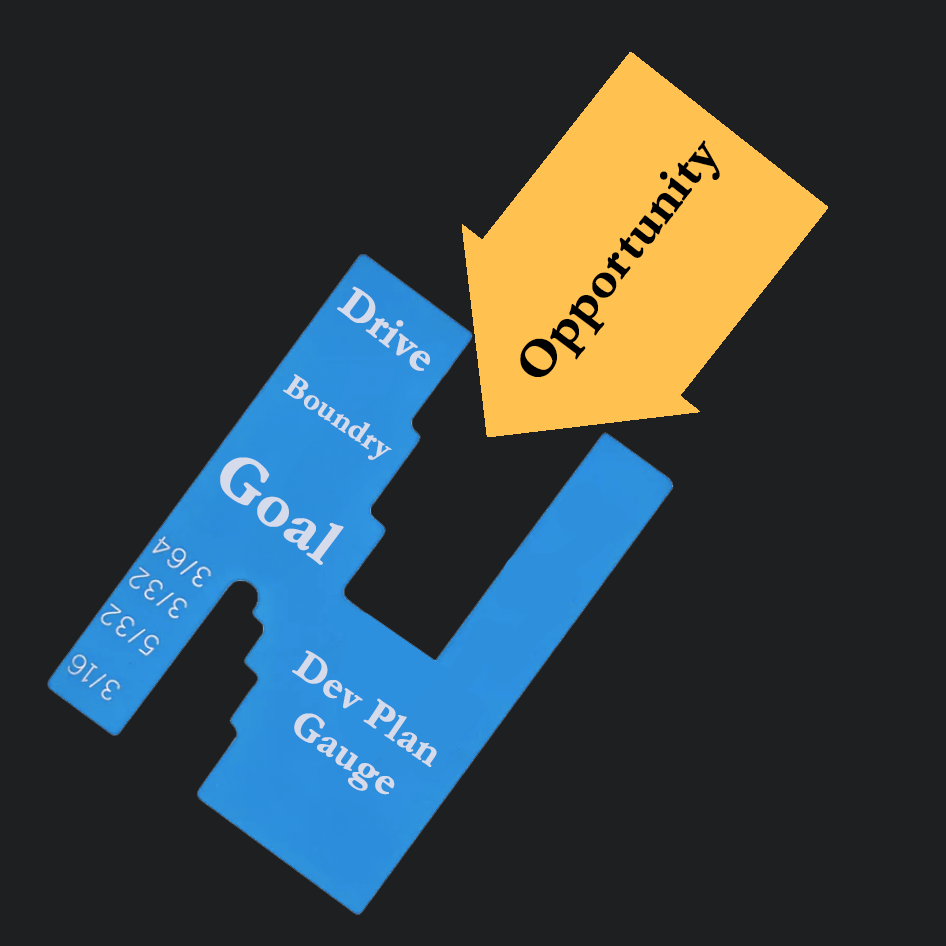
In manufacturing, there are tolerances that all parts must fit within, or they are “out of spec.” Sometimes, there is a mechanical gauge, snap gauge, limit gauge, or a Go-No-Go gauge to test the tolerance of a part quickly.
This is the kind of development plan we need to create; it is a quick gauge that aligns with everything we want to do, so when an opportunity arises, we can put it up against our development plan and say does that fit within our plan or not.
 Chalk X
Leave a comment