How much time is wasted in meetings?
According to Forbes, there are 55 million meetings daily, and at least half don’t accomplish much. Harvard Business Review surveyed 200 senior managers; only 17% said their meetings are generally productive uses of group and individual time. A recent survey shows 93% of workers complain about their recent meetings. Meetings are hated, wasteful, and most of our leaders don’t think they are productive. What can we do to fix them? Let’s look at a famous meeting that shares many common meeting problems and see how we can fix it.
The Council of Elrond from Lord of the Rings.
Broken down into two parts
Part 1:
Part 2:
Avoid meetings as a Lecture.
Elrond spends a lot of time reviewing why they are there but fails to give all the information and wastes a lot of time getting to the point. In the book Lord of the Rings, Elrond and Gandalf spend an entire day talking about the backstory of the one ring. Lucky for us, Peter Jackson and his team turned this into the movie’s prologue.
This highlights a common meeting mistake: meetings for classroom lectures. When we go to school, teachers provide information in class, and we mirror this behavior when we go to work. However, there is a shift in education to move information gathering outside the classroom and making the classroom time for active learning, i.e., working on problems, asking questions, and doing labs. This is sometimes called the flip classroom model and is being adopted at Harvard. I have had the opportunity to see this in action at the University of Kansas, where I am on the Engineering Advisory Board, and the students love this model. How can we Flip our meetings to this modern classroom setting?
Steven Rogelberg, author of The Surprising Science of Meetings: How You Can Lead Your Team to Peak Performance, may have the answer. First, provide the materials ahead of time. Second, change the agenda to a list of questions that must be answered.
Instead of this:
Agenda
- Review previous meeting notes
- Discuss architectural options
- Opens
Try this:
Agenda
- Which architectural pattern will we use with the product X?
Using questions is a forcing function. We remove the following:
- Review – If people wanted to review the information from the previous meeting, they should have reviewed the published notes or any materials provided beforehand.
- Opens – This agenda title is usually short for any other open topics anyone wants to discuss. This is a dangerous zone, which is not why we scheduled the meeting. It usually forces an excess number of people into a conversation they don’t need to be there for. Opens are scheduled waste.
When there is a straightforward question, the meeting is over when it is answered. This doesn’t mean scheduling an open-ended meeting. Having a short meeting time is still essential to avoid wasting time. Parkinson’s Law is the idea that work expands to fill the time available for completion.
Another way to speed up a meeting is to have it while standing, which, according to research, shortens meeting times by 34%.
Perhaps Elrond’s agenda should have been:
- Who will take the ring to Mount Doom to destroy the one ring while avoiding Sauron’s eye and not using it for themselves?
When working on your agenda, what if there is no question to be answered?
- This should have been an email/message or, in our scenario, a scroll sent by Elrond.
What if the question seems too big to be answered?
- Break the questions down into things that must be answered before the final question can be answered. For example:
- Who can we trust to take the ring?
- Are there any risks between here and Mordor that may require special skills, and what are those skills? Say a Balrog of Morgoth
- What must we do to ensure that our enemy doesn’t know our plan?
- …
What if you don’t think the question can be answered in the meeting?
- Perhaps you need to break up the meeting and/or change the attendees.
Who are all these people
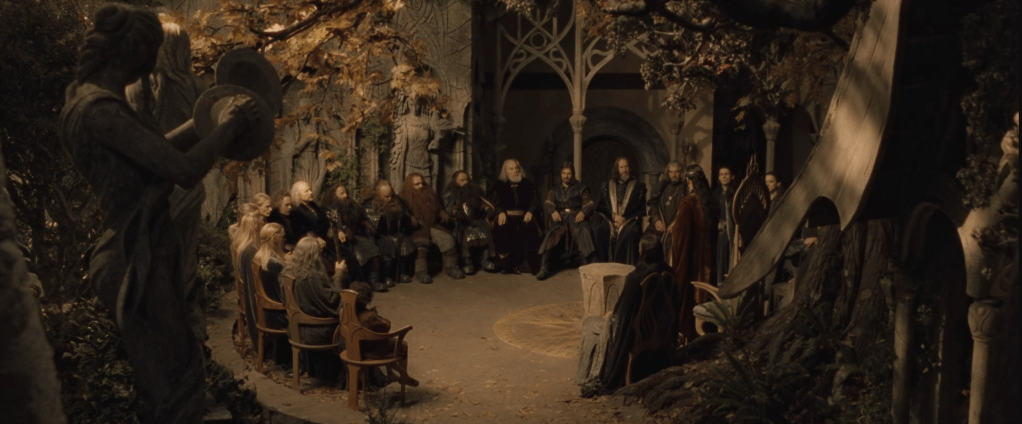
In the council of Elrond, there are four elves, four dwarves, and four humans who never speak except when there is a chance to argue. Why were they invited? Moreover, why did they travel from distant lands to attend a meeting to which they had nothing to contribute?
All too frequently at work, we accept a meeting based on availability, who scheduled it, who else is in it, and various other factors. I have been lucky enough to work at a company that tries to avoid these typical meeting traps and even had a course on effective meetings. However, the most powerful feature of this training and shared culture is that meeting attendance is not mandatory. We don’t have to attend if we don’t feel it is relevant.
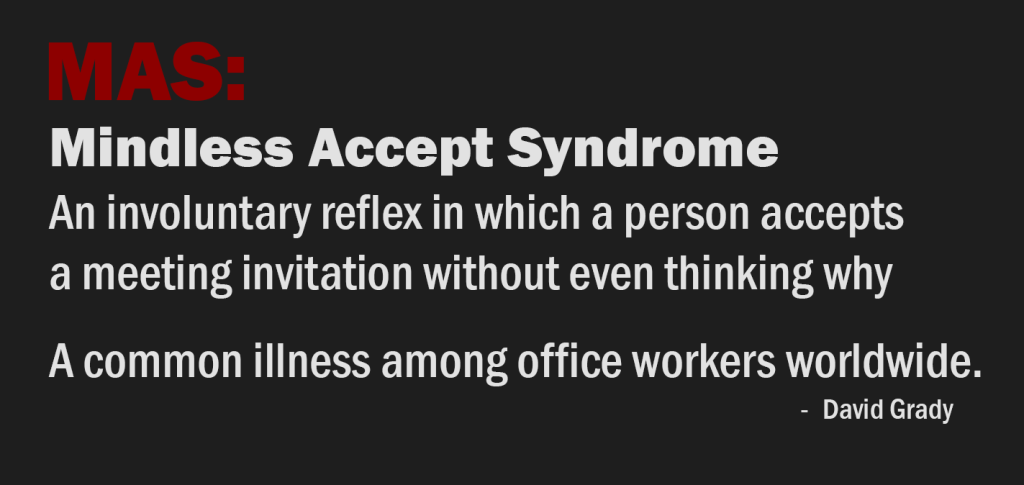
Even if you don’t have this culture at your company, you probably accept meetings and have the power to say no. David Grady has a humorous TED talk about the MAS problem. MAS stands for Mindless Accept Syndrome. Just because you receive an invite, don’t attend just because it is from Elrond.
A Hollywood example of a great meeting
Why is it good?
- There is a clear agenda and to the point, no extra topics.
- The agenda is: “How do we fit this in a hole made for this using nothing but that?”
- Explicit constraints to the situation: everything on the table is what we can use.
- The scene doesn’t mention time, but this team knows the time constraint and the audience.
- They are all standing to solve the problem.
- All those involved are working on the agenda problem.
- Everyone actively participates, and there are no extra attendees.
- The result of the meeting is practical and can be replicated outside the meeting. They create procedures so the astronauts can replicate their design, which you can see here.
Recurring meetings
One thing that doesn’t fit into the Council of Elrond example is improving reoccurring meetings. For recurring meetings, it is essential to take time as a team to reflect on what can be improved. In agile, they call this a retrospective. The standard beginner retrospective agenda is three questions.
- What went right?
- What went wrong?
- What can we do to fix what went wrong?
These questions are open-ended, but they can be effective when starting. In teaching retrospective classes, I highlight optimizations that need to be made to this pattern, but I will hold that topic for a future article.
Summary of meeting improvements:
- Always have an agenda.
- Create a document, video, scroll, or other asynchronous communication when sharing information before the meeting.
- Agenda topics should be in the form of a question to avoid lectures disguised as meetings.
- Create shorter meetings than you think. The work will fill the time allowed.
- Stand when possible.
- Only invite the essential few needed to answer the questions.
- Don’t say yes to everything. Avoid MAS
- Answers from a meeting should be shared so that the meeting doesn’t repeat elsewhere.
- Hold periodic retrospectives for recurring meetings to improve them.

 Chalk X
Leave a comment