Summary
- In the past 40 years the focus in business school and in industry is around efficiency (lean, six sigma, theory of constraints), but effectiveness and market timing are becoming even more important as the rate of change in markets is increasing.
- Businesses fail faster on what they build than on how much it costs to build.
- Figuring out a balance of effectiveness, efficiency, and at the right time is a business’ delivery cadence or frequency. The market has its own cadence/frequency. Aligning your business frequency to the market is the key to a long-lived successful business.
- By using lean or other efficiency tools without a priority on effectiveness you maximize waste not minimize costs.
- Designing users centric products that can easily adapt to the market allows for better control of matching the market.
A parable:

In the 1980s video tapes (beta/VHS) became the first way to watch a movie in your home. Initially, tapes were expensive to buy, a newly released movie could sell for $100 and the VHS player itself would cost $400. As a result, most people could own a player but not own many movies. This was a clear problem and market opportunity. Video rental stores popped up to fulfill the demand for borrowing movies. Blockbuster Video came to dominate the video rental store business by boasting dozens if not hundreds of VHS copies of the latest film releases.
In 1999 a startup entered the video supply marketplace, Netflix. VHS had been replaced by DVDs, which were much smaller and lighter. Netflix understood that DVDs unlike VHS could be sent cheaply in the mail. Netflix also used a sophisticated recommendation algorithm for their users on what to rent next. This algorithm helped them keep users and figured out what and how many movies to buy. It is worth noting this algorithm also helped them later to understand what sort of content to create. Blockbuster ignored this growing alternative. Netflix even offered itself for sale to Blockbuster in 2000, but Blockbuster declined to buy them.
Blockbuster kept growing the number of stores and the amount of real estate it had and by 2004 it has 9,094 stores across the world. Blockbuster tried to compete with Netflix in 2004 when it launched its own online video rental service. While they changed their distribution channel blockbuster altered very little of their actual business, with little in the way of movie recommendations and a commitment to late fees they failed to capture market share.
In 2005 YouTube entered the marketplace. They didn’t have movie rentals, but you could stream video directly from the internet. This was taking some of the demand away from movie studios and traditional entertainment providers. There was enough ad potential in the streaming market that in 2006 Google purchased YouTube for $1.65 Billion. The market was moving again.
Netflix saw this huge market opportunity and launched its own online streaming service only a year later, in 2007. They negotiated distribution deals with various movie and television studios. Blockbuster again tried to play catch up and bought an online movie rental company, Movielink. Blockbuster couldn’t shake their old product model and tried to rent each digital movie for the same price as a physical copy in their store. Perhaps they didn’t want to compete with themselves, but their competition offered unlimited viewing through monthly fees or advertising.
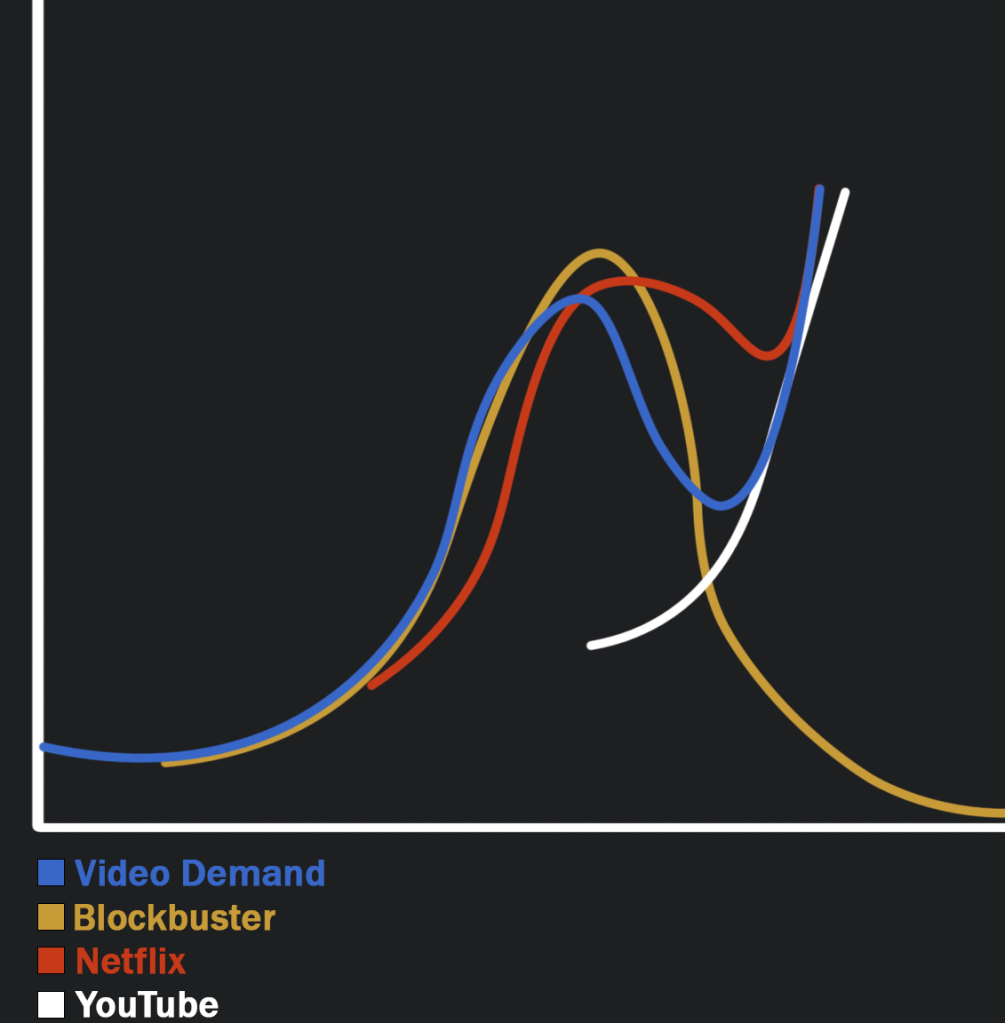
This is a story we hear of often in business. Businesses stick to how they are currently making money rather than switch to where the market is going. Netflix and Blockbuster had very similar mission statements. See if you can spot the difference
- Blockbuster’s Mission: To be the global leader in rentable home entertainment by providing outstanding service, selection, convenience and value.
- Netflix Mission: We want to entertain the world.
Blockbuster’s existence was bound to RENTING. As soon as people had a better option, Blockbuster was out of business. Netflix’s Mission statement is open enough so they can move with the market, DVD by Mail -> Streaming -> Video Game company. Netflix has several games available on your phone right now. Search for Netflix in your app store and you can play them so long as you have a Netflix subscription.
Kodak created the first digital camera in 1975 and killed it because it didn’t match their mission.
- Kodak’s Mission: With a focus on print and advanced materials and chemicals, we strive to deliver innovative products and solutions that care for people and the planet and fuel sustainable growth for Kodak and our customers.
- A better mission could be: We help you capture and share memories.
Your mission statement can kill your business if it focuses on what you build and not who you serve.
Market Hz vs Business Hz
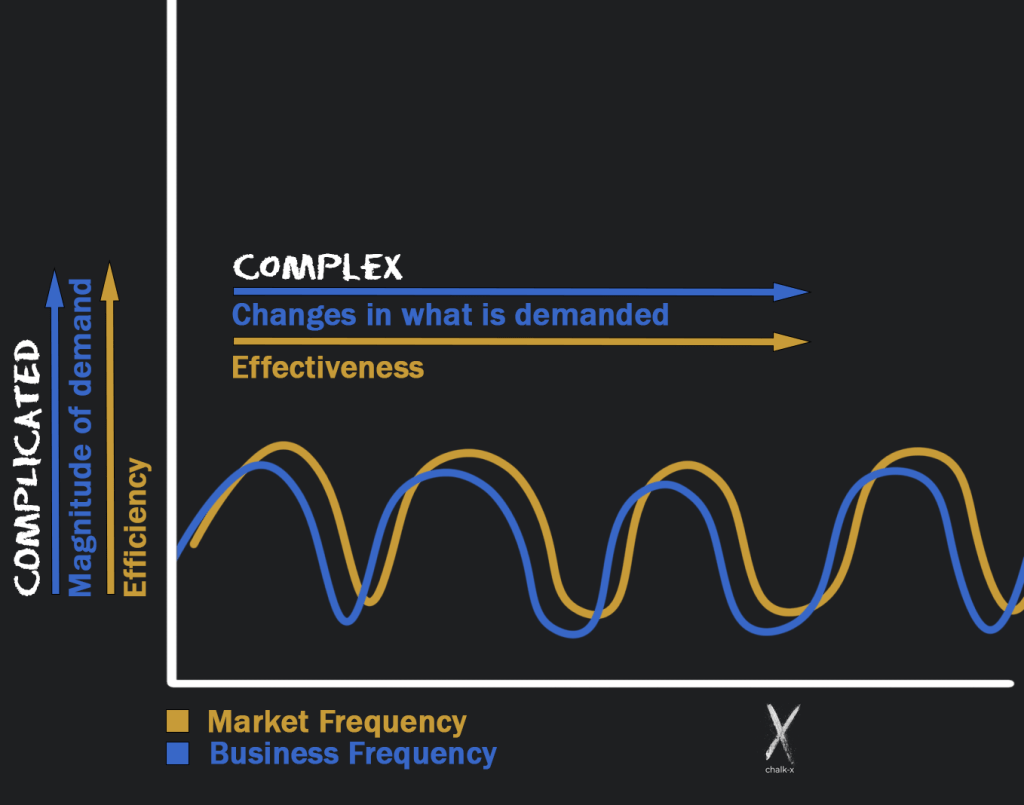
Having a mission statement that allows freedom for adaptability highlights the importance of a flexible business model. But how do we effectively respond to the market? In economics 101 we learn about the supply demand curve. The lower the supply and the higher the demand the more we can charge for the product we are selling. The supply demand curve is actually a snapshot of a specific time, the two lines are continually moving around over time. The rate of change of supply and demand is the frequency of the market and your business’s ability to match the market over time.
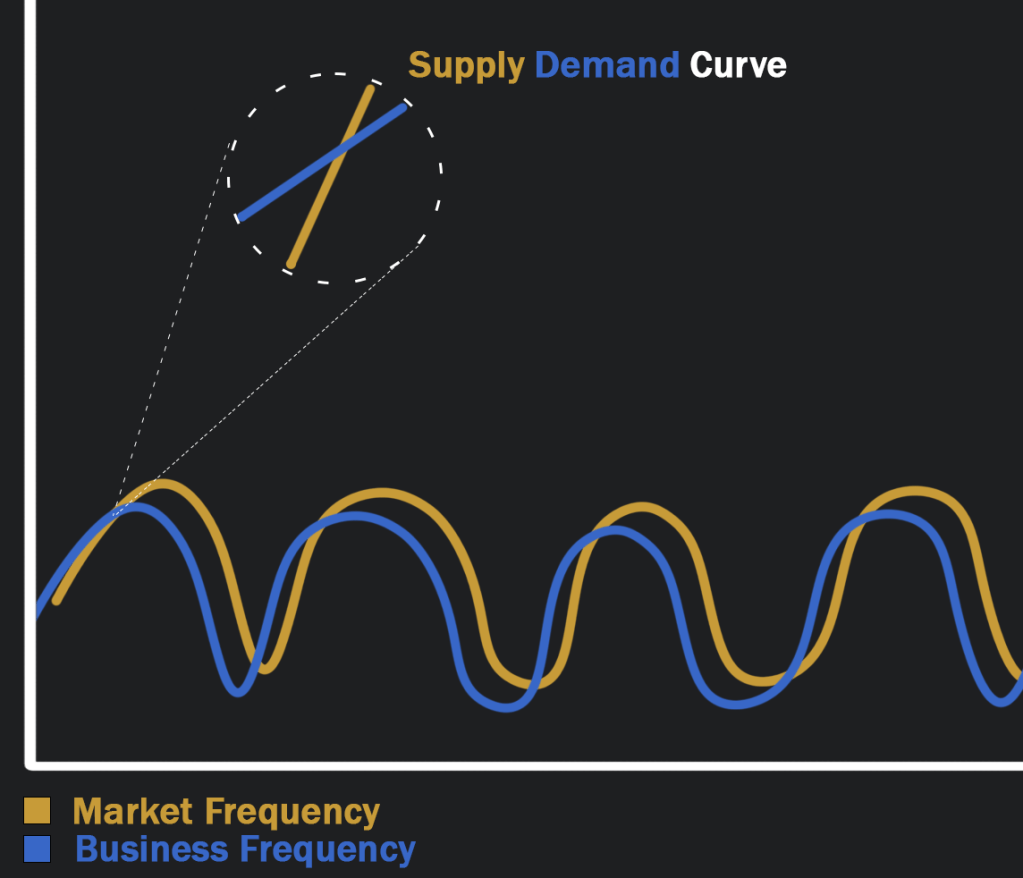
Frequency has a magnitude and rate of change over time. In business, we have product availability and product market fit at any given time. If demand increases we increase supply. As time goes on the market may move to alternatives. We must change our products to keep ahead or lead that change.
To illustrate this consider both the Market and Business frequencies as vector functions.
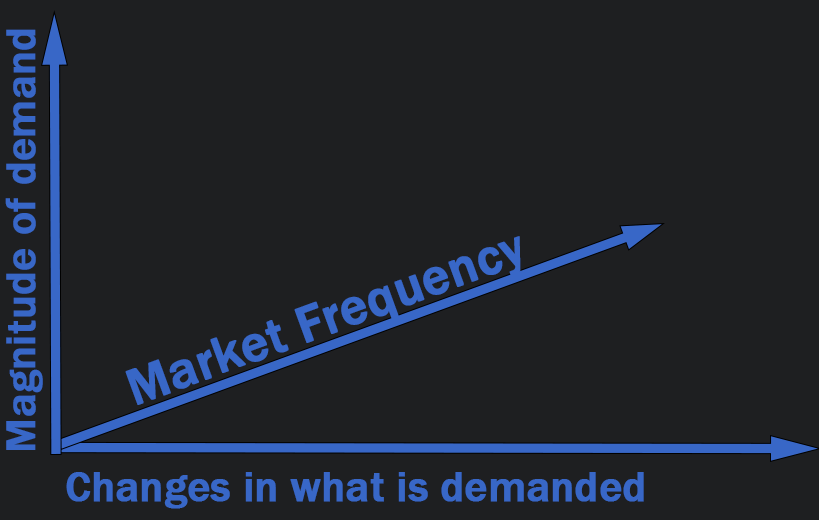
Market Frequency = Magnitude of Demand x Changes in what is demanded
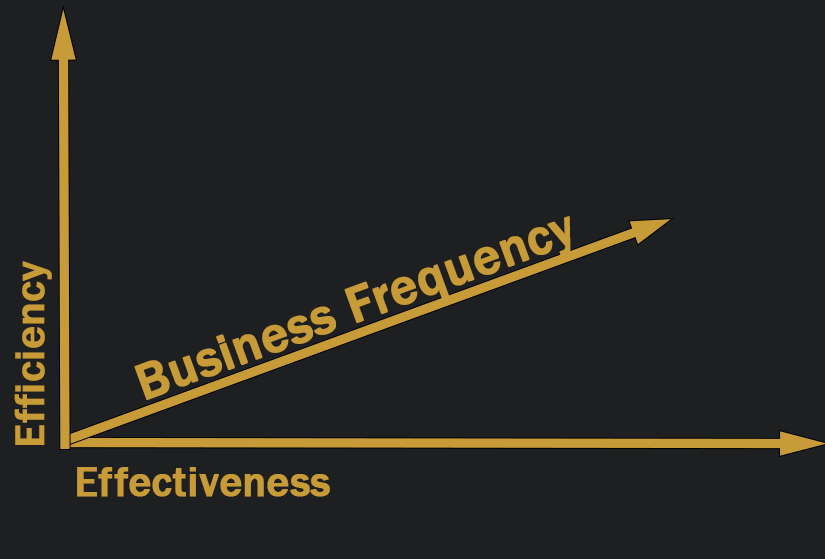
Business Frequency = Efficiency over time x Effectiveness over time
Market Frequency
Let’s start with the supply of tickets for a show at a local theater. The demand changes based on the available seats left to purchase. Ticketmaster, love or hate them (and honestly most of us do), has figured out real-time demand-based pricing. They use technology to get information to follow the demand for a given event and price tickets not once but continuously based on current market demand. A ticket to see singer Marcus King maybe $50 on Tuesday, but then he performs on the Tonight Show. Tickets start to sell quickly and as the scarcity increases ticket prices balloon to $250.00 Wednesday morning. The real-time pricing is based on a standard supply-demand curve. The user demand vs availability in the market for a particular place, time, and product offering.
However, over time we must factor in competition and alternatives, which is a far more complex problem. After all, Marcus King has several albums on various streaming services for cheap or free. If he doesn’t have a new album for his next tour and is touring his old one, people may not demand to see him live. The weather may be bad, or there may be a pandemic. What should the next tour look like to be as or more successful?
“Ticket price” and “next tour” illustrate the different components of market frequency. As a business, addressing each component is difficult because they have different levels of complexity. In my previous article, I used the Cynefin model to outline the necessity to solve problems of different complexity with different methodologies. When we adjust our business we need to keep both components driving the market over time in mind.
Business Frequency
Much of last century’s business innovations centered around delivery efficiency, how much inventory to hold, and how fast you can make it. Made famous by Goldratt’s book, The Goal, efficiency can be achieved with processes like just-in-time delivery, theory of constraints, and lean manufacturing. This critically helps reduce cost and these processes are still critical today. These processes are about making a recipe better and faster, but not making new recipes. This is a complicated process, for sure, but it won’t help our business adapt to the market. Let’s look at how to balance both sides of business frequency when it comes to software.
Software Frequency

Software delivery has multiple methodologies that focus on efficiency. Each delay in getting a solution to the customer reduces the efficiency component in the business frequency equation. In software delivery, these delays should be minimized and bottlenecks removed, just like Goldratt taught us. The book The Phoenix Project (by Kim, Berr, and Spafford), is the spiritual successor to Goldratt’s book written about IT departments. If you are in an IT department, work with one, depending on one, or have software in your business then you should read this book.
Innovation, creativity, and product design come from a complex domain. These domains work best with experimentation and feedback. However, the success of Goldratt, Lean, and Six Sigma has made us think we can bundle product discovery with efficiency. We start to think about project delivery in terms of assembly and fail-safe processes.
Here are some common things you may have heard in around software delivery:
- If we double our velocity, we’ll be more successful.
- We need to increase the number of lines of code that are written.
- We are in a time crunch. Let’s hire more contractors so we can get more output.
- I found some cheaper developers that can produce twice as much code for a third the price.
There are two huge problems with focusing maximum efficiency like this:
- Our users don’t care. They don’t care about development costs. The first thing they care about is, do they want it. Costs can discourage purchases but aren’t the reason for purchasing. The closer the development team is to users and the more interactions the better they can figure out what users want. As the cost of getting and using feedback goes up (different geographies and binding contracts) the effectiveness goes down.
- Excess production is precisely what lean warned against. If our focus is on maximizing the utilization of a worker or team, that is just as bad if not worse than maximizing a single machine’s output. Producing unwanted products faster means we are creating waste more quickly, which increases our costs.
Fast low cost production for unwanted products is an illusion of efficiency.
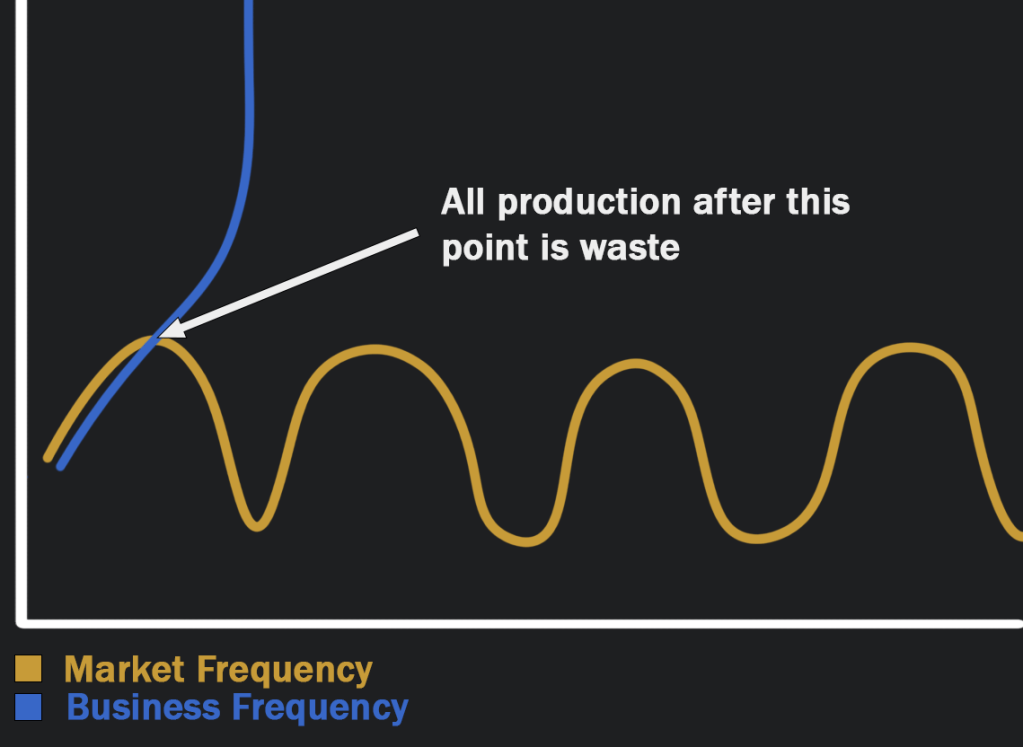
Melissa Perri, consultant, author, and podcaster calls this focus on feature production over value creation, the Build Trap. She has been a pioneer and advocates for good product management and I highly recommend her book, The Build Trap, and her podcast Product Thinking.
Creating Resonance
To create a resonance between the Market and Business Frequencies we need to tune our business with the two components we can control:
- Effectiveness – Complex – User centric design that can adapt with the market
- Efficiency – Complicated – Lean Delivery
In this article, I want to highlight a few high-level conditions for creating effective products. In my article(s) I will go into detailed examples.
User Centric
Effectiveness is matching the change rate of your users’ problems and alternatives. How do we do this? It is a complex problem and requires probing and testing our assumptions about our customers’ problems. Probe for understanding the user’s problem and how they solve it today. To do this we may do customer interviewing, user story mapping, mockups, prototypes, and more. It can also start with using analytics from a system to see how and if users are using our software. I outlined some of these in my article about product development. The key is that we continually work to test our assumptions about our users’ problems and how we can uniquely deliver a solution to them.
Adaptable Products
Our product has to be adaptable. Even if we understand where the market is going, how fast can we pivot and vector in the direction of the market? Blockbuster had limitations that Netflix didn’t. Blockbuster didn’t realize early enough that it needed to pivot. They also scaled fast to create 9000+ stores but this asset turned into a burden and they were unable to change their business model fast enough.
In software, do we have anything like 9000+ stores we can’t move? Inside most companies we do: mainframes, databases, old versions of software, systems created by contractors who left, or anything difficult to change. We treat software like a toaster but it is more like a jungle. A good recent example of this is Southwest still runs its scheduling software on a mainframe. December 2022 a bug in that software caused them to cancel 16,7000 flights and cost them $800 million in operations and $300-$350 million in lost revenue. I’m sure keeping the old software was “cheap” until it wasn’t.
Software that can’t be changed is a liability not an asset
We need our systems to meet the cadence of the market. Luckily there are ways to decompose software products to get this done. The goal is to design our end product in a modular way, think Lego blocks. In software, this can be done with APIs and Event Streams, but it isn’t limited to software. You can see modularity in semiconductors that use Chiplets instead of large single purpose processors.
By decoupling the product into modular blocks each can innovate or change at their own rate. This is key because not all aspects of market demand change at the same rate. People have wanted the same car for a while but the features in the car change frequently, for example, Bluetooth connectivity vs tires. Being able to update the features that are changing at a faster rate than the underlying car decouples the innovation rates of each component.
Adaptable Organization
One of the reasons you may not have modular products and systems today is that your organization probably isn’t set up for them. Conway’s Law states:
Any organization that designs a system (defined broadly) will produce a design whose structure is a copy of the organization’s communication structure.
Melvin Conway
Most business organizations still have a structure that mirrors those originally created in the 1850s to keep trains on time. As a result, when a large project needs to get done we spend a bunch of time trying to coordinate different teams across various schedules. If you have the misfortune of using scaled agile development frameworks you can actually see this dysfunction. In one such framework, where they actually call programs trains, they use red strings tied to interdependent features to get the timetable right. The more interdependence you have across teams the more red string you have.
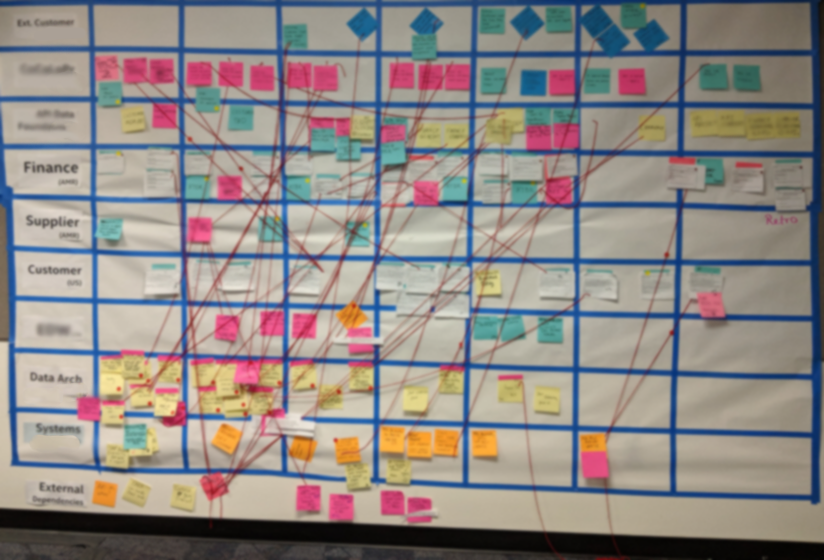
This may be a good method for finding organizational dysfunctional, but not a way to create a long-term adaptable system. Each dependency is a sign that any change in the market will require every feature, team, and system in the chain to change. Trains don’t change their destinations easily.
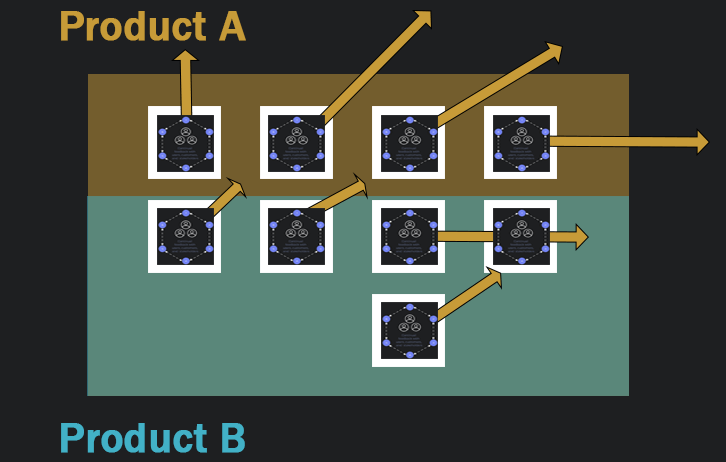
Trying to minimize the manual dependency between teams is key. One way to do this is to have a product team that owns a modular component of your product/organization and the systems associated with it. A consistent team with expertise in a product’s component will know how to change it, if necessary. They don’t need to know the whole system but they do have to know their users immediately up and downstream. By having each node focus on user-centric design the net system will be more adaptable. Any higher-level product can be composed of the modular products these teams deliver.
Efficiency
Efficiency is important in software development but not in the number of features we deliver but rather in how long a new idea takes to get any one feature into production. This is everything we learned about lean but applied to the development environment. What are the key signs of waste in software development? Code reviews, change control boards, submitting requests via a ticketing system, or really any manual steps of any kind. The value of these manual steps is important but waiting for them is an impediment to our adaptability. The Phoenix Project and its companion book The DevOps Handbook are good primers for maximizing software and organizational efficiency.
Possible Usage:
- Make sure your mission statement is open ended and not fixed to one business model.
- Ensure that you are getting constant and consistent signals of usage from your users. If the market is moving but you aren’t aware of it then your business cadence could be off.
- Find things in product delivery that impact feedback from users and eliminate them. This could be time delays between the team and the users or worse time delays between team members. The cost of delays are greater than a loss in NPV, they could be the loss of the market.
- Map a project to see how many teams need to coordinate manually to get something done. Work to decouple the dependencies between those teams through automation and/or APIs.
- Determine how long a new feature takes to get released. Find bottlenecks in the process and eliminate them one by one.


Leave a Reply